Interactive Timeline of Fresno Plumbing
Every major infrastructure project, material milestone, company founding, code change, and drought event that shaped Fresno's plumbing history — from 1868 to 2026. Filter by category or search a keyword.
1860s – 1870s: The First Wells
Wheat farmer Anthony Y. Easterby purchases a large tract east of what will become downtown Fresno — the seed of Central Valley agricultural irrigation.
Church — still honored as "Father of Fresno Irrigation" — is hired by Easterby to build the diversion canal that becomes the Fresno Canal.
Formal incorporation of Church's canal operation — the first agricultural water utility in Fresno County. Later evolves into the Fresno Irrigation District.
Fresno Station is laid out along the new rail line. For the first four years, households drill their own wells or haul from ditches — no municipal water yet.
George McCollough and Lyman Andrews sink a 100-foot well on Fresno Street with a steam pump feeding a 23,000-gallon elevated tank. This is where Fresno's plumbing history begins.
2,000 shares at $10 par ($20,000 capital). Founders: Leach, McCollough, Froelich, Silverman, Kutner, Camy, Ferguson. The "1885 founding" claim cited in some sources is off by eight years.
1880s – 1890s: Codes, Iron, and the Tower
Senate Bill No. 132 — California's first statewide regulation of plumbing work — is signed into law, decades before the UPC exists.
The city takes on municipal responsibilities but still contracts water service to a private company. Municipal ownership won't come until 1931.
Downtown Fresno gets its first true water-main network. Some cast iron mains from this era remained in service well into the 20th century.
A 54-mile wooden flume carries lumber and water from the Sierra down to Sanger — one of the longest lumber flumes ever built. Documented by the Fresno County Historical Society.
Architect George Washington Maher. 109 feet tall, 250,000-gallon capacity, $20,000 construction cost. Modeled on the Worms, Germany water tower. Continuously operated until 1963.
1900s – 1920s: Consolidation and the IAPMO
Renamed the Fresno City Water Company. The same trio would go on to build Kerckhoff Dam and shape Central California's early hydroelectric grid.
Fresno City Water Company expands mains within the city and extends service to outlying districts, coinciding with Fresno Traction Company streetcar expansion.
A dedicated newspaper begins documenting local infrastructure, water disputes, and plumbing-code adoption — a critical historical source for this era.
39 plumbing inspectors meet in Los Angeles to form the International Association of Plumbing and Mechanical Officials, led by Charles Collard. The organization behind the Uniform Plumbing Code (UPC) is born.
The private utility that had been Balch/Kerckhoff/Wishon's Fresno City Water Company changes hands to Cal Water Service.
The Contractors State License Board is created (originally the "Contractors License Bureau"). The C-36 plumbing classification remains the 3rd-largest of the 44 classifications today.
1930s – 1940s: Municipal Ownership and Friant Dam
The date, dollar figure, and transfer that turned Fresno's water into a municipal utility. The commonly repeated "1911 municipalization" claim is off by twenty years.
Per company history — one of the older continuously operating plumbing shops in Fresno County.
Samuel O. Blanc invents the electric drain-cleaning machine in Iowa. Roto-Rooter will eventually expand into full-service plumbing in Fresno as a franchise.
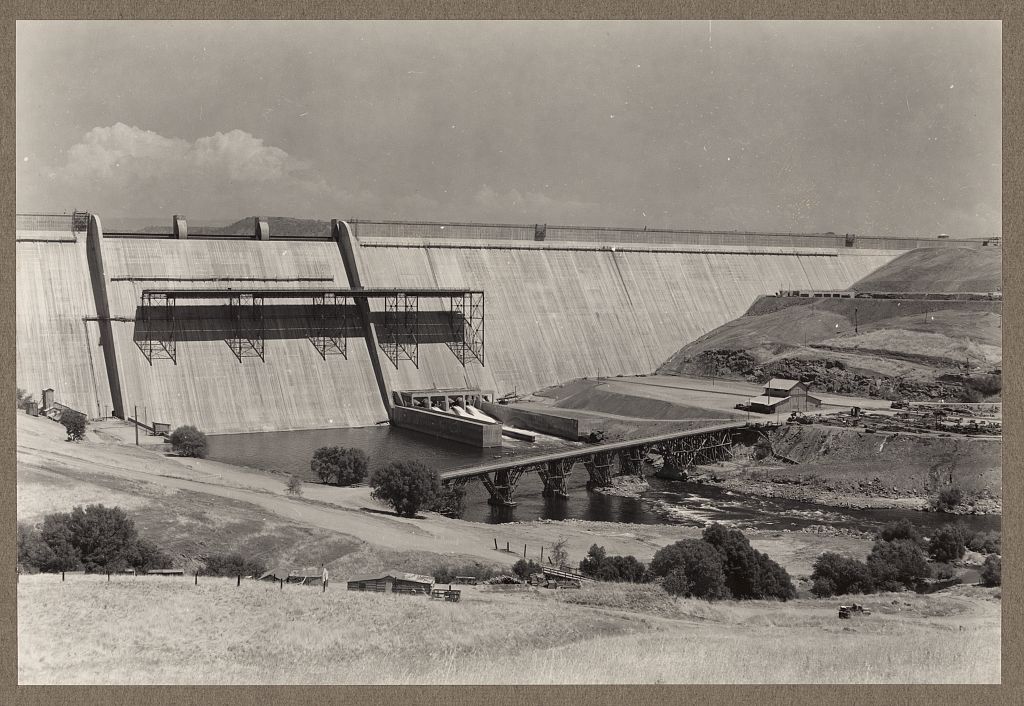
319-foot-tall concrete gravity dam, 3,488 feet long, forming Millerton Lake. The linchpin of the federal Central Valley Project and Fresno County's largest single water infrastructure project.
36-mile aqueduct running north from Friant Dam to Ash Slough near Chowchilla, delivering Kings/San Joaquin water to Madera County agriculture.
The IAPMO's first UPC is published as a California-only code. It later spreads across the western US and today applies (in modified form) as the California Plumbing Code, Title 24 Part 5.
152-mile canal running south from Friant Dam through Fresno, Tulare, and Kern counties to Bakersfield. One of the longest earthen canals in the US.
1970s – 1980s: Drought, Efficiency, and CPVC
A network of shallow basins in northeast Fresno designed to replenish the aquifer with surface water — still critical to Fresno's groundwater management.
Two consecutive dry years drive statewide policy on plumbing efficiency for the first time — setting up the toilet-flush and low-flow fixture mandates of the following decade.
Senate Bill 331 unifies California's building standards under Title 24. It also mandates 3.5-gpf toilets as the first statewide flush-volume reduction, effective January 1.
A generational shift for one of Fresno's longest-tenured plumbing firms — formally incorporated three years later.
One of Fresno's larger HVAC-plus-plumbing operations begins under the Lee family (per company account).
Formal incorporation date on file with the California Secretary of State. Roto-Rooter also expands into plumbing services nationally this year.
Chlorinated PVC is approved for hot-water use nationally, but California begins an environmental review process that stretches out over a full quarter-century.
A bellwether local ordinance ban of bituminized-fiber Orangeburg pipe, driven by "documentation of several failures." Model codes across the country follow over the next several years as PVC and ABS replace Orangeburg.
The last major U.S. producer of bituminized-fiber sewer pipe shuts down under Flintkote ownership. Existing Orangeburg laterals installed in Central Valley homes 1945–1972 begin exceeding their nominal 50-year design life.
California bans lead solder and lead pipe in public water systems after 1985 — 18 months ahead of the federal statute. Fresno's water utility begins the transition to lead-free installation.
The Safe Drinking Water Act amendment defines "lead-free" as ≤0.2% for solder and flux and ≤8.0% for pipe. Ends the era of legal 50/50 tin-lead solder for new potable-water plumbing nationwide. Pre-existing joints are not required to be removed.
The Uniform Plumbing Code delists lead from approved potable-water pipe materials, and California incorporates the 1986 federal lead ban into state code. Newly constructed Fresno homes from 1988 forward should not contain lead service lines.
1990s – 2000s: 1.6 GPF, ABS Bans, and Meter Wars
The federal Energy Policy Act follows within months, making 1.6 gpf the national standard for new residential toilets.
The mandate broadens from new construction only to any toilet installation in California — retrofits included.
Health & Safety Code 17921.7 makes California the only US state with this stricter ABS purity requirement, following well-documented brittle-failure lawsuits.
A Tennessee state court approves what was then "the biggest property damage settlement in U.S. history," covering PB systems and yard service lines installed between January 1, 1978 and July 31, 1995. Any "gray plastic" pipe from that era in Fresno homes is polybutylene, not PEX.
Polybutylene exits the U.S. plumbing market — pulled by class-action litigation and market withdrawal, not by a single code-committee delisting vote. The material remained approved in some model codes for years afterward despite no longer being manufactured.
The first comprehensive plan for balancing groundwater, surface water, and reclamation in Fresno — the framework that would guide the next two decades of investment.
Ordinance 2002-3 adds the current backflow-prevention section to Fresno's Municipal Code, aligning with California cross-connection requirements.
Northeast Surface Water Treatment Facility — Fresno's first move away from 100% groundwater dependence for municipal supply.
Voluntary federal certification for water-efficient fixtures — the industry foundation for high-efficiency toilets, faucets, and showerheads that later become mandatory in California.
The 25-year environmental review process ends. The 2007 California Plumbing Code (Title 24 Part 5) formally allows CPVC for hot- and cold-water distribution.
California's High-Efficiency Toilet law — effective for new construction 2014, all installations 2016. The strictest flush-volume standard in the US at the time.
2010s – 2020s: PEX, Lead-Free, and Modern Codes
SB 1334 and SB 1395 set California's maximum lead content in wetted surfaces at 0.25% — four years before the federal standard would match it.
Among the last major California cities to universally meter residential water. The delayed rollout stretched into the 2010s decade.
After multiple court battles and a full environmental impact report, PEX pipe is legalized in California. California was the final US state to allow PEX — a fact that shaped Fresno's slab-repipe options for decades.
The federal government finally matches California's stricter lead-free threshold, four years after Fresno plumbers were already installing to the 0.25% spec.
The start of the 2014–2017 drought — the driest 4-year period in California's instrumental record. Triggers Executive Order B-29-15 and accelerates fixture-efficiency mandates.
Statewide efficiency standards for toilets (1.28 gpf), showerheads (1.8 gpm), and faucets (1.2 gpm) roll out across new construction and retrofit installations.
Fresno Municipal Code §11-107A (amended by Ord. 2016-44) prohibits galvanized malleable iron, galvanized wrought iron, and galvanized steel — both underground and inside buildings — for new work within city limits. Existing galvanized pipe remains legal in place but cannot be added to, extended, or replaced in kind.
Senator Padilla's 2009 bill fully phases in for residential: every single-family home sold in California must have low-flow toilets, showerheads, and faucets installed.
The multifamily and commercial phase of SB 407 takes effect — sale, transfer, or major renovation of any building in California triggers low-flow retrofit requirements.
EPA publishes revisions to the Lead and Copper Rule in the Federal Register, requiring public water systems to develop initial lead-service-line inventories — a foundational step for the coming full-replacement mandate.
Title 24 Part 5, based on the 2021 IAPMO UPC. This is the code currently governing every Fresno plumbing permit as of publication.
Federal Register publication of the final LCRI creates a new "Galvanized Requiring Replacement" (GRR) category and requires public water systems to fully replace all lead and GRR service lines within 10 years of the compliance date — the strictest lead-pipe mandate in US history.
Public water systems must begin executing their lead/GRR service-line replacement plans. Every remaining lead or galvanized-behind-lead service line in the Fresno area is on the path to mandatory replacement.