Plumbing in Fresno began the way it did in most Central Valley towns: with a well, a windmill, and no plan. The Southern Pacific platted the townsite in 1872, but for the first four years there was no municipal water — households drilled their own wells or hauled from ditches. The first real system appeared in 1876, when two men named George McCollough and Lyman Andrews sunk a 100-foot well on Fresno Street with a steam pump and a 23,000-gallon elevated tank. That single well is where this story starts.
What follows is not one story but five interlocking ones: how water infrastructure grew from that well to Friant Dam and beyond; how pipe materials shifted from cast iron to copper to CPVC to PEX — and how California uniquely fought each transition; how a handful of family plumbing companies became the industry's institutional memory; how the plumbing code itself was invented in Los Angeles in 1926 and has been rewritten every three years since; and how droughts, dust storms, and fires shaped every one of those decisions.
Two important corrections to popular retellings up front. The Fresno Water Company was not founded in 1885 — that is Fresno's own city incorporation date. The water works were built in 1876 and the company was incorporated in May 1877 (City of Fresno, Fresno Water History). And Fresno's water system was not municipalized around 1911 — the City did not take ownership until January 31, 1931, at a purchase price of $2.5 million (waterworkshistory.us, Fresno entry). Both dates get repeated wrong on the internet. Both are corrected here.
Part 1: Water Infrastructure (1868–Today)
Before Fresno: Yokuts, wells, and windmills
Prior to Euro-American contact, the San Joaquin Valley floor around present-day Fresno was occupied for millennia by Yokuts-speaking peoples — described by the Fresno County Historical Society as "63 tribes, known collectively as Yokuts" (Fresno County Historical Society, Fresno Settlement Timeline). The Yokuts used the valley's sloughs, wetlands, and river floodplains seasonally for fishing and gathering rather than building engineered water-diversion systems. When the Central Pacific Railroad platted a station on its Southern Pacific line in 1872, no municipal water existed — every household relied on "private wells and windmills," a condition explicitly noted in the 1919 History of Fresno County, California, with biographical sketches, which reports the first Fresno water works "[did] away largely with private wells and windmills" (1919 History of Fresno County, full text via archive.org).
Irrigation before plumbing: Moses J. Church and the canal companies
Fresno's irrigation water infrastructure predates its domestic water infrastructure by several years and involved an entirely separate cast of characters. A.Y. Easterby bought 5,000 acres east of the future townsite in 1868 and in 1870 commissioned Moses J. Church — still honored locally as the "Father of Fresno Irrigation" — to divert water from the Kings River. Church formally organized the Fresno Canal and Irrigation Company in February 1871 (Fresno Irrigation District, History).
By 1875, the first agricultural "colony" — the Central California Colony — established roughly 4,000 acres of irrigated land south of the future downtown, seeding the region's raisin and agricultural economy. Church consolidated control by 1885, then Dr. E.B. Perrin bought the company outright in 1887. Perrin acquired the 48,000-acre Rancho Laguna de Tache land grant in 1891 for roughly $1 million specifically to secure its senior water rights, and by 1892 the company held a claim to 2,500 cubic feet per second of Kings River riparian rights — a claim that (per the district) still underlies its water entitlement today (Fresno Irrigation District, History).
Kings River infrastructure serving the broader county included the Sanger Flume, built in 1889 through Kings River Canyon to move lumber and water down from the Sierra to Sanger — documented photographically by the Fresno County Historical Society (Wikimedia Commons, from Hank Johnston's They Felled the Redwoods, 1966).

1876–1877: The Fresno Water Company is born
The story most sources get wrong. In the spring of 1876, a public meeting called ostensibly to discuss fire protection instead produced a committee — Dr. Lewis Leach, A. Kutner, A.M. Clark, R.H. Fleming, and George McCollough — charged with building the town's first water works. The chairman was H.S. Dixon, the secretary W.H. Creed, and the contemporary Fresno Expositor newspaper skeptically remarked it had "no faith in anything being done, at least not until after the town is burned down" (1919 History of Fresno County).
McCollough and Lyman Andrews built the physical plant in 1876: one pumping station, small pumps, two storage tanks, all located on Fresno Street between J and K. The first well was 100 feet deep with 7-inch casing pipe, a steam pump, and a 23,000-gallon elevated tank — said at the time to be the height of the tallest building in town. A second 12,000-gallon tank was added in 1878, and a more powerful well bored in 1881 (waterworkshistory.us, Fresno entry, citing the 1892 Memorial and Biographical History of Fresno, Tulare and Kern Counties).
The company itself was formally incorporated in May 1877 with $20,000 in capital stock (2,000 shares at $10 par value). Founding directors, per contemporary newspaper filings: Lewis Leach, George McCollough, Otto Froelich, H.D. Silverman, A. Kutner, Simon Camy, and J.W. Ferguson. Primary sources: "Fresno Water Works," Fresno Republican, March 31, 1877, p. 3; "Incorporations," Sacramento Bee, April 17, 1877, p. 3 (Morris A. Pierce, waterworkshistory.us).
Fresno itself did not incorporate as a city until 1885 — nine years after its water works were built and eight years after the Fresno Water Company was chartered. The two dates get conflated all over the internet. They are not the same.
Cast iron and wrought iron: the first pipes in the ground (1887–1890)
By 1887 the company's capital stock had been increased from $20,000 to $200,000 (per the San Francisco Examiner, August 2, 1887), reflecting rapid buildout. Between 1887 and 1890, 4-inch and 2.5-inch cast-iron pipe and 4-inch wrought-iron water mains were laid throughout the growing downtown. The City of Fresno's own history page notes that "some of this original pipe" remained in service into the modern era — a fact any Fresno plumber cutting into 1890s cast iron in the historic downtown grid can still verify by hand (City of Fresno, Fresno Water History).
By the early 1890s the system drew from eight wells — most 250 to 300 feet deep, one 400 feet, one 600 feet — explicitly excluding surface water. A new Gaskell pump rated at 6 million gallons per day was installed to serve a projected population of 50,000, with reservoir storage of 120,000 gallons.
The plant changed hands repeatedly. Two conflicting figures survive for the 1890 sale: the Marysville Evening Democrat (April 3, 1890) reported the entire plant sold to the Municipal Investment Company of Chicago for $500,000, while the 1919 History of Fresno County's biography of Dr. Leach states he "was president of it until 1890 and sold it for $140,000." The discrepancy may reflect two different transactions or a reporting error in one of the two period sources; the historical record has not been reconciled.
1894: George Washington Maher builds the Water Tower
Of every structure in Fresno's plumbing and water history, the 1894 Fresno Water Tower is the best documented — owing largely to its 1971 National Register of Historic Places nomination. Chicago architect George Washington Maher, a contemporary of Frank Lloyd Wright associated with the American Arts and Crafts movement, was commissioned by the Fresno Water Company (via a group of Chicago-connected investors) in 1891. He modeled his design on a water tower in Worms, Germany, built only four years earlier (KVPR, "The story behind Fresno's historic water tower").
The tower was completed in 1894 at a cost of $20,000, at the corner of Fresno and O Streets. It stood 109 feet high, held 250,000 gallons, and — when full — weighed over 2 million pounds. Its American Romanesque brickwork used double-wall construction: an inner wall roughly 2 feet thick, an outer wall of approximately 14 inches, separated by a 3-foot-wide passage/tunnel space, laid in successively smaller courses toward the top for its distinctive beehive silhouette (Historic Fresno, NRHP nomination summary by William E. Briam). The original design included an unbuilt library intended for the second and third floors.
The Water Tower remained in continuous service until 1963. The 1888 pumping station at Fresno & O Streets went out of continuous service in 1959, but the tower itself stayed operational for another four years. The second floor was removed and the interior remodeled into a visitor center in 2001 (Fresno Convention & Visitors Bureau), and the Fresno Arts Council took over building operation in October 2014 — today it houses a gallery and gift shop (fresnoflyer.com, "Under Your Nose – Fresno Water Tower").
1904, 1926, 1931: three ownership changes and one municipalization
In 1904 the Fresno Water Company was purchased by Balch, Kerckhoff & Wishon — the same men who would go on to build Kerckhoff Dam and shape Central California's early hydroelectric grid. They reorganized the company as the Fresno City Water Company. In 1910, during Fresno's building boom (coinciding with the Fresno Traction Company's streetcar expansion), the water company spent $25,000 on new mains within the city and on service extensions to outlying districts.
In 1926, the California Water Service Company purchased the plant and distribution system from Fresno City Water Company. And on January 31, 1931, California Water Service Company sold the entire system to the City of Fresno for $2.5 million. That is the date, dollar figure, and transfer of ownership that turned Fresno's water into a municipal utility (City of Fresno, Fresno Water History; waterworkshistory.us). The oft-repeated "1911 municipalization" claim is off by twenty years.
1937–1949: Friant Dam and the Central Valley Project
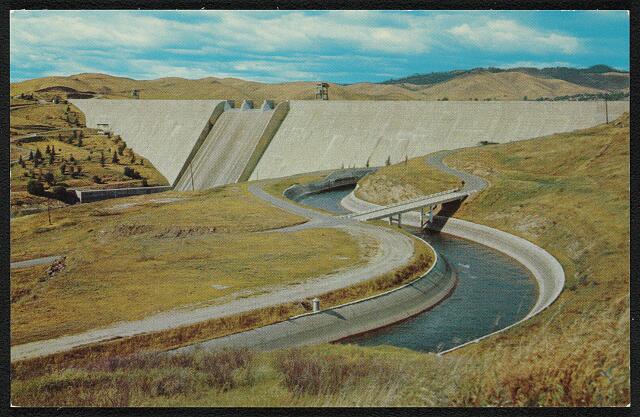
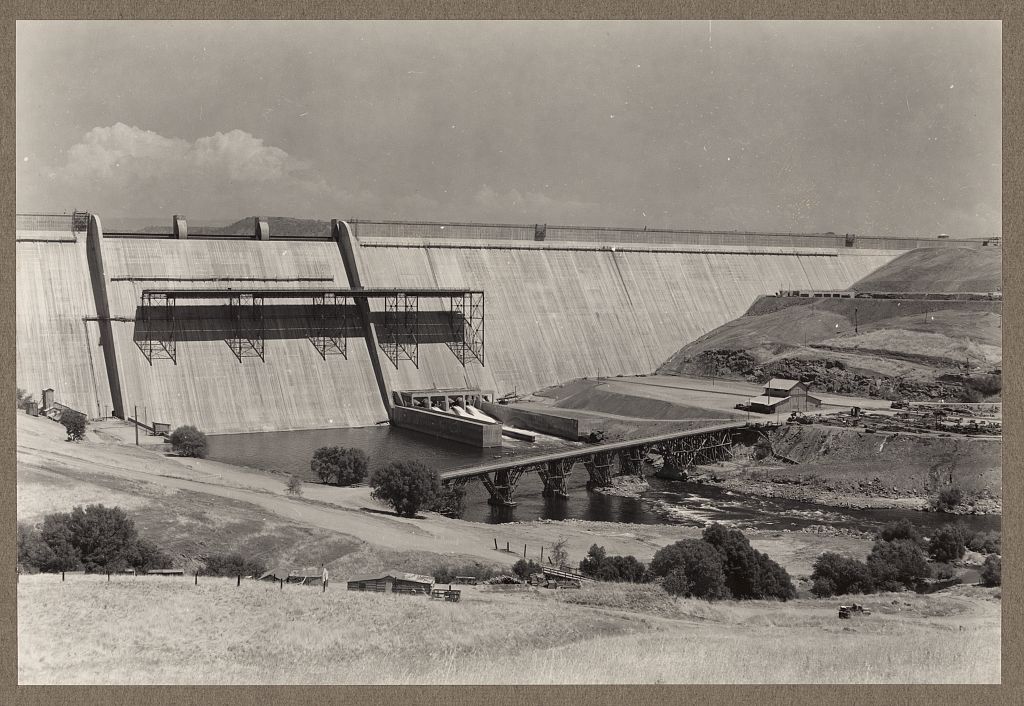
Fresno's mid-century water future was federal. The site of what became Friant Dam had been used before: in 1880, the Upper San Joaquin Irrigation Company built an 800-foot, 6-foot-tall rock diversion dam near the same location, intended to irrigate 250,000 acres. Floods destroyed it within two years (Wikipedia, Friant Dam).
The modern Friant Dam was authorized under the 1935 Rivers and Harbors Act as the centerpiece of the federal Central Valley Project, funded initially with $20 million from the Emergency Relief Appropriation Act of 1935. Site surveys ran November 1935 through early 1936; a workers' camp was established at Friant in January 1938; construction began in 1937 and the dam was completed in 1942, with drum gates installed in 1947. It is a concrete gravity dam, 319 feet high and 3,488 feet long, impounding Millerton Lake (520,528 acre-foot total capacity, 4,900-acre surface area) on the San Joaquin River on the Fresno–Madera county line, roughly 15 miles north of downtown Fresno.
Millerton Lake submerged the site of the town of Millerton — the first county seat of Fresno County. Two canals distributed its water: the Madera Canal, running 36 miles northwest to Ash Slough near Chowchilla, was completed in 1944; the Friant-Kern Canal, running 152 miles south to the Kern River at Bakersfield, was completed in 1949 (Friant Water Authority, History).
The Friant Water Authority's own institutional history is candid about why the dam was built: it addressed "unsustainable groundwater pumping that had caused major land subsidence" alongside the "needed economic development to support the influx of population to California that began with the Dust Bowl of the 1930s and continued for two decades." Dust Bowl migration and Friant Dam are, in the historical record, the same story.
The groundwater crisis in one statistic
By the mid-20th century, Fresno had a groundwater problem no amount of new wells could solve. From the City of Fresno's own history page, one figure captures it: the water table beneath Fresno dropped from less than 30 feet below the surface in 1930 to more than 128 feet below the surface by 2009. In 1956 the Water Division pumped 16,384,942,000 gallons (50,283 acre-feet) at an operating cost of $166,171.78 for a city of about 111,000. By 1960 there were 45,879 water customers (City of Fresno, Fresno Water History).
The modern response has been layered. The Leaky Acres recharge facility began directing water into the aquifer in 1973 — an early formal groundwater-recharge effort. In 1989, Fresno County Waterworks Districts were merged into the City's system. In 1996 the City adopted the Fresno Metropolitan Water Resource Plan, a formal response to chronic groundwater overdraft. In June 2004 the City's first Surface Water Treatment Facility (northeast Fresno) began delivering treated surface water. In 2005 the City Council renewed its Central Valley Project water-service contract with the U.S. Bureau of Reclamation for a 40-year term.
In 2010 — late by any state or national standard — Fresno began installing residential water meters. It was one of the last major California cities to move to metered residential billing. The Recharge Fresno project began in 2016. The Southeast Surface Water Treatment Facility was completed in 2018 (City of Fresno, Fresno Water History).
Part 2: How the Pipes Changed (Materials, 1876–2026)
Every plumber working in Fresno today opens up walls that record 150 years of material choices. What follows is the material lineage in code-verified order, with a specific focus on California's uniquely combative regulatory posture toward newer plastics.
Cast iron and wrought iron (1887–1930)
Fresno's earliest documented supply piping was cast and wrought iron: 4-inch and 2.5-inch cast iron pipe and 4-inch wrought iron mains laid 1887–1890 across the downtown grid, with some of that original pipe remaining in service well into the 20th century per the City of Fresno's own account (City of Fresno). Cast iron soil pipe for drain, waste, and vent applications was universal in commercial and larger residential construction well past mid-century.
Galvanized steel and lead (1900–1960s)
The general national pattern — galvanized steel supply piping paired with lead-based drainage components and lead solder — was universal in Central Valley residential construction from the early 20th century through the mid-1960s. No Fresno-specific ordinance mandating either material's use or removal has been located; the shift happened as codes modernized and as galvanized's internal corrosion and mineral scaling reduced its practical service life to 40 to 50 years. Any Fresno plumber cutting into a pre-1965 home should assume both materials are present.
Copper Type L (1950s–1980s)
Copper tube for potable water became commercially practical in the 1930s and was standardized nationally through subsequent decades. By the 1950s and 1960s, Type L copper was the default choice for potable water piping in California residential construction, and it remained essentially unchallenged until CPVC and PEX finally cleared their state regulatory hurdles in 2007 and 2010, respectively. Copper Type L remains fully code-compliant in the current 2022 California Plumbing Code.
ABS drain-waste-vent pipe and California's targeted 1995 ban
ABS (acrylonitrile-butadiene-styrene) plastic pipe was widely adopted for drain-waste-vent applications in California residential construction from the mid-1970s onward. But by the early 1990s, "thousands" of California homes were experiencing cracking and leaking failures traced to a specific manufacturing defect: ABS pipe made with nonvirgin, reprocessed plastic resin in violation of the ASTM specifications incorporated by the Uniform Plumbing Code. The Legislature responded with California Health & Safety Code §17921.7 (Cal. H&S Code §17921.7 summary). The industry trade press summarized it plainly: "The State of California has banned the use of 'regrind' or recycled plastic resin for use in ABS drain-waste-vent pipe... The California ban takes effect January 1, 1995" (BuildingGreen, "California Bans Recycled Plastic Resin in ABS Pipe," Nov. 1, 1994).
This is worth stating precisely because it is almost always stated wrong. California did not ban ABS pipe. California banned ABS pipe manufactured from recycled or regrind resin. Virgin-resin ABS pipe manufactured to ASTM specification remains fully legal in California today.
CPVC: nearly 25 years of stops, starts, and litigation
CPVC (chlorinated polyvinyl chloride) is where California's regulatory conservatism first became visible on a national stage. Commercial CPVC production began in 1959, with the first NAHB Research House incorporating CPVC piping built that year in East Lansing, Michigan. Additional demonstration houses followed by 1963 in California, Maryland, and Ohio. ASTM D-2846 (copper-tube-sized CPVC) was standardized in 1968; ASTM F441 (iron-pipe-sized CPVC) in 1974. The National Standard Plumbing Code adopted CPVC in 1978; the Council of American Building Officials followed in 1981. In 1982, CPVC was added to the national Uniform Plumbing Code (PHCP Pros, "A History of CPVC in Residential Plumbing").
Then California went its own way. Despite national UPC acceptance in 1982, California restricted CPVC to limited applications — buildings of two stories or fewer, and only in areas where documented water or soil chemistry caused premature copper failure — for nearly 25 years. Work on the state Environmental Impact Report began in 1982, stalled in the late 1980s, and did not resume in earnest until roughly a decade later amid litigation. Full, unrestricted statewide approval finally came in 2007, via a unanimous California Building Standards Commission vote placing CPVC into the 2007 California Plumbing Code (Contractor Magazine, "California Approves CPVC Pipe"; Consulting-Specifying Engineer). One trade publication described the process as "nearly 25 years of stops, starts, litigation and environmental review."
PEX: the fully documented multi-decade saga
If CPVC took 25 years, PEX (cross-linked polyethylene) took even longer — and its journey through California's regulatory apparatus is the most rigorously documented pipe-approval saga in American plumbing history. The timeline is worth walking through step by step because it explains why California remains the strictest state in the country for pipe approval today.
- 1998: Under an outgoing Republican administration, a state Environmental Impact Report concludes PEX poses no health threat.
- May 2002: California adopts an updated plumbing code that deletes PEX pending a fresh EIR.
- September 2002: The Plastic Pipe and Fittings Association (PPFA) sues the state.
- February 2003: PPFA wins; the court issues a peremptory writ of mandate ordering the California Building Standards Commission to adopt the 2000 UPC provisions allowing PEX (Plastic Pipe & Fittings Assn. v. California Building Standards Com., No. B166499, opinion).
- November/December 2004: A California Court of Appeals ruling (finalized December 15, 2004) holds that PEX is still subject to full environmental review under the 2001 code cycle, though local jurisdictions retain authority to approve it independently in the meantime.
- October 2007 – December 2008: A comprehensive EIR is conducted covering air and water quality, product performance, waste generation, recycling, energy use, and natural-resource impacts.
- January 2009: The CBSC certifies the EIR and unanimously adopts regulations approving PEX for inclusion in the California Plumbing Code.
- August 1, 2009: PEX formally takes effect in the California Plumbing Code.
- December 2009 – January 2010: Alameda County Superior Court (Judge Frank Roesch) rules the EIR was inadequate and orders the CBSC to rescind PEX approval. PPFA appeals and loses.
- Effective July 1, 2010: The CBSC is forced to repeal PEX's inclusion in the state code, pursuant to court order.
- August 16, 2010: CBSC vote — effective August 18, 2010 — re-approves PEX for the 2007 California Plumbing Code, this time with five specific mitigation conditions.
- January 1, 2011: The same PEX approval carries forward into the 2010 California Plumbing Code.
California is explicitly documented as the last state in the nation to approve PEX at the state regulatory level (PM Engineer, "Pipe Rollercoaster"; Contractor Magazine, "California approves PEX for plumbing — again," Sept. 2, 2010).
The five mitigation conditions still in force today are worth memorizing if you plumb in Fresno: (1) underground PEX must be sleeved in impermeable material; (2) recirculating hot-water PEX must meet ASTM F876-08; (3) PEX brass fittings must meet NSF/ANSI 14-2009 (to prevent dezincification and stress-corrosion cracking); (4) new-construction PEX systems must undergo a minimum one-week double-flush protocol with fixture tagging; and (5) all PEX must carry a minimum 30-day UV-protection rating.
The 2020s material landscape
Today's Fresno plumber has three legal supply-piping choices for potable water: copper Type L, CPVC, and PEX (A or B). All three are fully code-compliant under the 2022 California Plumbing Code (Title 24 Part 5). Cast iron and virgin-resin ABS remain compliant for DWV. Galvanized steel supply pipe is legal in existing systems but is essentially never specified in new work. Lead solder has been federally prohibited since 1986 for potable water systems.
Part 3: The Companies (1932–Today)
Fresno's oldest continuously operating plumbing companies span four generations of family ownership. Founding dates are treated cautiously here — company self-reported histories don't always survive scrutiny against public filings, and where discrepancies exist, they're flagged rather than papered over.
Allbritten Plumbing Heating & Air (1932)
Allbritten's own account: "Back in 1932, Allbritten started as a small plumbing shop right here in Fresno... Our founder earned the nickname 'The Barefoot Plumber' because he'd take off his boots before walking into customers' homes — a tradition we still honor today with our signature blue booties" (Allbritten, About Us). The 1932 founding date is independently repeated in a 2021 trade-press announcement of a private-equity investment: "Founded in 1932, Allbritten offers plumbing, heating and air conditioning services to homeowners in the Fresno area of California" (Contractor Magazine, "Redwood Announces Investment in Allbritten"). No independent historical record (city directory, incorporation filing, newspaper archive) confirming 1932 has been located — the date rests on Allbritten's own account.
Fresno Plumbing & Heating, Inc. (Kumpe family, 1978–1981)
Better documented. In 1978, the Kumpe family — Andrew and Wilma Kumpe and sons Gary, Larry, and Dean — purchased the company from prior owners at a time when the only surviving part of the business was an ACE Hardware store. The family formally incorporated in 1981. Larry Kumpe (currently President) and Dean Kumpe (Secretary/Treasurer) came from an L.A. construction background, had worked with their father until 1967 before entering the plumbing trade, and grew the company from a single Ford Courier pickup truck with no field employees to a staff of 227 in Fresno (Fresno Plumbing & Heating, About).
The Better Business Bureau's filing corroborates: Business Started 12/1/1978; Business Incorporated 6/11/1981; BBB File Opened 12/19/1989 (BBB, Fresno Plumbing & Heating Inc.). The company's "80+ years" claim on its website appears to refer to the predecessor hardware/plumbing business under prior ownership, not 80+ years under Kumpe family ownership specifically.
Lee's Air, Plumbing & Heating (circa 1980)
Lee's Air states it has "been servicing Central and Northern California for over 40 years... we've grown significantly since our humble beginnings in 1980" (Lee's Air, Our Story). The BBB filing lists Business Started 9/1/2000, Business Incorporated 10/16/1991, and BBB File Opened 10/1/1973 (BBB, Lee's Air Plumbing & Heating). The three dates are internally inconsistent and likely reflect a corporate reorganization or name change — "circa 1980, per company account" is the most defensible way to state it.
Roto-Rooter: 1935 nationally, plumbing only since 1981
Nationally, Roto-Rooter was founded in 1935 by Samuel Oscar Blanc in West Des Moines, Iowa, who built the first sewer-cleaning machine from a washing-machine motor, wagon wheels, and a 3/8-inch steel cable — inventing what is described as the world's first heavy-duty plumber's snake (Wikipedia, Roto-Rooter). The company was incorporated as Roto-Rooter, Inc. in 1936; the original device's patent expired in 1955; the company was acquired by Chemed Corporation in 1980; and Roto-Rooter expanded into plumbing services (beyond drain cleaning) for the first time only in 1981 (Funding Universe, "Roto-Rooter, Inc. History"). That last fact matters: Roto-Rooter's plumbing services nationally are 46 years younger than its drain-cleaning brand.
Familian Pipe & Supply and the missing Fresno supply-house history
Familian Pipe and Supply Co. was founded in Los Angeles by the father of Isadore Familian (born 1911), who took over the business as a teenager after dropping out of high school. Familian became one of Southern California's dominant plumbing-supply distributors, eventually operating 23 showrooms with over $500 million in annual sales by the 1990s before a series of ownership changes (its related Price Pfister faucet manufacturing arm passed through Norris Industries, Masco, Emhart, Black & Decker, Stanley Black & Decker, and Spectrum Brands over subsequent decades) (Wikipedia, Isadore Familian). Whether Familian operated a Fresno branch and when is not established in the public record. Any working plumber with pre-1990 knowledge of local supply houses — Consolidated Pipe, Familian, or others — is invited to contribute to this history.
Part 4: The Codes That Govern Everything
Every plumbing installation in Fresno today is regulated under a stack of codes that trace their lineage to three specific events: an 1883 California Senate bill, a 1926 Los Angeles meeting of plumbing inspectors, and a 1978 California statute that unified the state's building code into a single title. Here is that lineage.
1880–1883: California's first plumbing law
The earliest identified California statewide plumbing regulation is Senate Bill No. 132 of 1883 — introduced by Senator Dougherty and signed into law on March 15, 1883, becoming Chapter LXXVII of the California statutes. Its seven sections established the essential regulatory framework still recognizable today:
- Master plumbers must register with the local Board of Health.
- Boards of Health must publish an annual list of registered master plumbers.
- No plumbing may be installed without a written plan first approved by the local Board of Health.
- Local governments must fund enforcement.
- Local courts are empowered to enforce the law.
- Violation is a misdemeanor.
- The law takes immediate effect.
San Jose adopted a conforming local ordinance on December 2, 1883 — titled "An ordinance in relation to the construction of house drains and plumbing work connecting with the sewerage system of the City of San Jose" — and San Francisco had already begun drafting its own conforming law before the governor signed the state bill (Wikipedia, Uniform Plumbing Code, "History"). This 1883 state law is almost certainly the direct legal basis under which Fresno (city incorporation 1885, water company from 1876–77) would have adopted its own early local plumbing ordinance(s) in the following two to three decades — though Fresno's specific first plumbing ordinance number and date has not been located in surviving municipal records.
Fresno's current Municode Chapter 13 (Sidewalks, Streets, and Public Ways) traces its lineage to "Orig. Ord. 1076," but the surviving text governs street/sidewalk drainage nuisance, not comprehensive plumbing installation: "No person owning or having in his possession or under his control any water pipe or drain shall permit the water therefrom to run across any sidewalk or public street so as to injure the same or obstruct the free travel thereon" (Fresno Municode, Chapter 13).
May 17, 1926: IAPMO is founded
The single most consequential event in the history of Western plumbing regulation occurred in Los Angeles on May 17, 1926, when 39 Southern California plumbing inspectors founded the International Association of Plumbing and Mechanical Officials — IAPMO. The founding president was Charles Collard; the association's secretary from 1926 to 1954 was Stephen Smoot. IAPMO's own history describes its origin as "the brainchild of a small group of Los Angeles plumbing inspectors" (IAPMO, IAPMO History).
The founding mandate, quoted directly: "to advance the latest and most improved methods of sanitation; to promote the welfare of and harmony between the owner, the builder, and the craftsman; to accomplish a uniformity in the application of the provisions of the ordinances; and to promulgate the mutual benefit of the members" (Wikipedia, IAPMO).
The first Uniform Plumbing Code was published in 1945, and — critically — "was originally only used in California," per IAPMO's own history page. This is the seed. From those 39 Los Angeles inspectors and that 1945 document, the entire modern American plumbing-code apparatus grew. IAPMO is now headquartered in Ontario, California.
August 14, 1929: The California CSLB is born; the C-36 emerges
Contractor licensing in California traces to the Great Depression. The Contractors State License Board was established on August 14, 1929, as the "Contractors License Bureau" under the Department of Professional and Vocational Standards. The first contractor's license was issued September 24, 1929 (CSLB, History and Background; Gravel2Gavel, "California Contractor License 1,000,000 Issued").
Originally, CSLB defined only three broad categories: Class "A" General Engineering, Class "B" General Building, and Class "C" Specialty contractors. In 1939, these categories evolved into the modern granular license "classifications" system, and CSLB began formally examining applicants on trade-specific qualifications — this 1939 shift is the likely origin point of the plumbing-specific C-36 classification.
As of December 31, 2020, the C-36 Plumbing classification held 15,859 active and 3,230 inactive licenses — 19,089 total. That makes plumbing the third-largest of CSLB's 44 classifications, behind only B-General Building and C-10 Electrical (Wikipedia, California CSLB).
License-count milestones offer a useful scale-of-industry timeline: #100,000 on January 19, 1948; #200,000 on April 19, 1961; #300,000 on November 18, 1974; #400,000 on February 10, 1981; #600,000 on August 7, 1990; #700,000 on December 8, 1994; #800,000 on October 1, 2001; #900,000 on July 12, 2007; #1,000,000 on January 10, 2015 (Gravel2Gavel).
Journeyman-level (uncertified, unlicensed) experience is distinct from licensure. CSLB's own FAQ defines a journeyman as "a person who has completed an apprenticeship program or is an experienced worker... fully qualified and able to perform a specific trade without supervision," but such a person cannot legally contract for permitted work, use employee labor, or exceed $1,000 in combined labor and materials on a job without an actual CSLB license (CSLB, Journeyman FAQs).
1978: Title 24 and the modern California Plumbing Code
Title 24 (the California Building Standards Code) was created by 1978 state legislation — SB 331 (Robbins) — which mandated that all building standards be unified into a single title of the California Code of Regulations, replacing a previously scattered arrangement across multiple titles. In 1988, SB 2871 (Marks) extended Title 24 to all occupancy types statewide, closing gaps where local jurisdictions had previously enforced varying model codes. In 1989, the California Building Standards Commission began combining California's specific amendments with the base model code into a single unified code book (DGS, History of the California Building Code, Title 24 Part 2).
Parts 4 (Mechanical Code) and 5 (Plumbing Code) of Title 24 are specifically based on IAPMO's Uniform Mechanical Code and Uniform Plumbing Code editions — confirming the direct institutional linkage between IAPMO/UPC and California's Title 24 Part 5. The triennial adoption/effective-date pairing, per DGS's own history page:
| Title 24 edition | Effective date | UPC/UMC base edition |
|---|---|---|
| 2010 | Jan. 1, 2011 (Energy Code Part 6: July 1, 2011) | 2009 UMC/UPC |
| 2013 | Jan. 1, 2014 (Part 6: July 1, 2014) | 2012 UMC/UPC |
| 2016 | Jan. 1, 2017 | 2015 UMC/UPC |
| 2019 | Jan. 1, 2020 | 2018 UMC/UPC |
| 2022 | Jan. 1, 2023 | 2021 UMC/UPC |
Source: DGS, History of the California Building Standards Code – Title 24.
Fresno itself does not maintain a separate comprehensive plumbing code. Fresno's Municipal Code Chapter 11, Article 1 simply adopts the state California Plumbing Code by reference via Ord. 2007-92 (effective January 17, 2008) and Ord. 2008-53 (effective October 9, 2008). This "adopt-by-reference" pattern is how Fresno has likely operated for most of its regulatory history.
Lead: 1986 federal, 2010 California, 2014 federal-catch-up
The lead-free saga cuts both ways — California once led, then the nation matched it. In June 1986 (specifically June 19, 1986), Section 1417 of the Safe Drinking Water Act (as amended) prohibited pipes, pipe fittings, plumbing fittings, fixtures, solder, or flux that were not "lead free" in the installation or repair of any public water system. The original federal definition allowed up to 8.0% lead in pipes and pipe fittings, 4.0% lead by dry weight in plumbing fittings and fixtures, and 0.2% lead in solder and flux (EPA, "Use of Lead Free Pipes, Fittings, Fixtures, Solder, and Flux for Drinking Water"; California DTSC, "Lead in Plumbing Legislation").
Effective January 1, 2010, California Senate Bills 1334 and 1395 (Statutes of 2008) amended Health and Safety Code §116875 and added §25214.4.3, tightening the state's "lead free" definition well below the older federal thresholds to a maximum of 0.25% lead in wetted surfaces (weighted average) plus 0.2% lead in solder and flux. That was substantially stricter than the federal rule at the time (California DTSC).
Effective January 4, 2014, the federal Reduction of Lead in Drinking Water Act (enacted January 4, 2011, with a three-year transition period) brought the national "lead free" standard down to match California's already-stricter 0.25%-wetted-surface threshold (USC FCC/CHR, "Summary of the Reduction of Lead in Drinking Water Act"). California's 2010 state law was effectively a four-year head start on what became the federal standard nationwide. The accompanying Community Fire Safety Act of 2013 separately exempted fire hydrants.
Low-flow: from 5.0 gallons (1975) to 1.28 gallons (2016)
The gallons-per-flush arc:
- 1975: 5.00 gpf
- 1980: 3.50 gpf
- 1992: 1.60 gpf
- 2011: 1.28 gpf
Source: California Energy Commission filing.
California law first required all toilets to use no more than 3.5 gpf effective January 1, 1978. Then California mandated that new construction use "ultra-low-flow" 1.6-gallon toilets beginning in 1992, and — via a state law championed by State Senator Lucy Killea — that beginning January 1994, only 1.6-gallon toilets could be sold or installed statewide, regardless of construction date (Los Angeles Times, Feb. 23, 1992). The federal Energy Policy Act of 1992 (EPAct 1992) then nationalized the 1.6-gpf standard, taking effect in 1994. California pushed first; the nation followed.
In 2007, AB 715 (Laird) tightened California's standard further, requiring 1.28-gpf toilets and 0.5-gpf urinals effective January 1, 2014. In 2009, SB 407 (Padilla) — Chapter 587, Statutes of 2009 — created the retrofit-on-sale/alteration regime: residential and commercial real property built and available for use on or before January 1, 1994 must have non-compliant plumbing fixtures replaced. The phase-in: triggered by building-permit alterations/improvements starting January 1, 2014; mandatory for all single-family residences by January 1, 2017; mandatory for all multifamily and commercial properties by January 1, 2019 (LegiScan, SB 407 full bill text; Sacramento Bee, Dec. 11, 2013).
Governor Jerry Brown's Executive Order B-29-15, issued during the 2014–2017 drought, then accelerated the fixture-efficiency standards further: toilets sold in California could not exceed 1.28 gpf effective January 1, 2016; bathroom faucets could not exceed 1.2 gpm effective July 1, 2016; showerheads could not exceed 1.8 gpm effective July 1, 2018 (Wikipedia, Low-flow fixtures).
EPA's WaterSense program — the federal water-efficiency label — launched June 12, 2006, at the American Water Works Association's Annual Conference in San Antonio, Texas; through the end of 2024 it reports having helped save a cumulative 9.9 trillion gallons of water and $245 billion in consumer utility costs nationally (EPA WaterSense, "Accomplishments and History").
Backflow and cross-connection control
California maintains statewide backflow prevention regulation via the State Water Resources Control Board's Cross-Connection Control Policy Handbook (CCCPH). Fresno's own current cross-connection/backflow ordinance is codified at Section 6-804 of the Fresno Municipal Code, originally added by Ord. 2002-3, §11, effective 2-11-02, and amended by Ord. 2012-11, §1, effective 7-30-12. The ordinance requires backflow-assembly testing by a "backflow prevention assembly tester, certified by either the American Backflow Prevention Association or the American Water Works Association, operating under a valid business license from the City of Fresno," and contains 21 detailed sub-requirements governing assembly types, permissible locations, and testing frequency (Fresno Municipal Code, Sec. 6-804).
Seismic strapping and earthquake gas shutoff
California's Department of General Services, Division of the State Architect (DSA) certifies two categories of automatic gas shutoff valve for residential structures: the Excess Flow Automatic Gas Shutoff Valve (EFV) and the Earthquake Sensitive Automatic Gas Shutoff Valve (ESV). Current EFV standards (effective January 1, 2020, under the 2019 California Plumbing Code) require compliance with the 2017 edition of ASTM F2138-12 for natural-gas service, or ANSI Z21.93-2017/CSA 6.30-2017 for natural and LP gas up to 5 psig. DSA certification standards update automatically six months after each new plumbing-code edition is published (DSA, "Gas Shutoff Valve Certification for Residential Structures"). Water-heater seismic strapping is required per California Plumbing Code Section 508.2.
Part 5: The Historical Events That Shaped Fresno Plumbing
1922: The Fresno Bee
The Fresno Bee published its first edition on October 17, 1922, launched by the McClatchy family (owners of the Sacramento Bee, in continuous publication since 1857) as an entirely new venture rather than a purchase of an existing paper. The first edition ran 60 pages and was delivered to 12,000 homes, with another 4,000 copies sold on the street; Fresno County's population was approximately 129,000 at the time, growing by an estimated 5,000 people per year (Fresno Bee, 100th-anniversary feature, Oct. 17, 2022). Carlos K. McClatchy, grandson of Sacramento Bee founding editor James McClatchy, served as the Fresno Bee's first editor. The Bee absorbed its main local rival, the Fresno Morning Republican (itself dating to 1876), in March 1932. The Fresno Bee switched from an afternoon to a morning paper on December 6, 1976.
Why does a newspaper's founding date belong in a plumbing history? Because the Fresno Morning Republican published the March 31, 1877 article documenting the Fresno Water Works — the primary source for the water company's founding date. Without that newspaper, half of Fresno's plumbing history would be lost.
1930s: The Dust Bowl and Friant Dam
Friant Dam's institutional history is unambiguous about causation. The dam was built to address "unsustainable groundwater pumping that had caused major land subsidence" alongside the "needed economic development to support the influx of population to California that began with the Dust Bowl of the 1930s and continued for two decades" (Friant Water Authority). Fresno's mid-century plumbing infrastructure and the migration of dispossessed Oklahoma and Texas farm families to the Central Valley are one linked story.
1976–1977: The first great drought
Described by the California Department of Water Resources' own retrospective as "the worst in the State's history" at the time, with 1976 the fourth-driest year of record and 1977 the single driest year ever recorded up to that point (California DWR, "The 1976–1977 California Drought – A Review," May 1978). The drought's regulatory legacy was California's first serious statewide push toward water-efficiency standards, which culminated in the 3.5-gpf toilet mandate effective 1978.
1987–1992: The second great drought
The 1987–1992 drought produced the political pressure that gave California its 1.6-gpf toilet mandate (1992 new-construction, 1994 all-installations), championed by State Senator Lucy Killea. It also birthed the federal Energy Policy Act of 1992, which then took California's 1.6-gpf standard national.
2014–2017: The third great drought and Executive Order B-29-15
On January 17, 2014, Governor Jerry Brown declared a drought emergency, citing conditions as "perhaps the worst drought that California has ever seen since records began being kept about a hundred years ago," and called for a 20% voluntary reduction in water use (NPR, Jan. 17, 2014). This drought produced the accelerated fixture-efficiency standards described in Part 4 — the 1.28-gpf toilet, 1.2-gpm bathroom faucet, and 1.8-gpm showerhead limits that govern every fixture sold in California today.
2020–2022: The most recent drought
Drought conditions expanded and worsened across California and Nevada through 2020, driven by below-average precipitation, a weak monsoon, above-normal temperatures, and record wildfire activity (Drought.gov, "Drought Status Update and 2020 Recap: California, Nevada"). The regulatory legacy of the 2020–2022 drought is still being written.
Part 6: Banned & Phased-Out Materials
Every generation of plumbers inherits the materials of the previous generation and, eventually, the recall list of the one before that. What follows is the honest history of what Fresno homes were built with — and why some of it is no longer legal to install, no longer legal to leave in the ground, or no longer sold.
Galvanized steel supply pipe: never a national ban, but banned in Fresno
Contrary to a common misconception, the Uniform Plumbing Code and the California Plumbing Code have never formally deleted galvanized steel from their list of approved potable-water pipe materials. A 2024 peer-reviewed historical-code review found that "galvanized iron and galvanized steel were included in the materials for water distribution pipe, tubing, and fittings for most, if not all, editions" of the UPC, National Plumbing Code, Basic Plumbing Code, and Southern Standard Plumbing Code, and that "galvanized pipe continues to be an approved material in the current model codes" (Devine et al., Water Practice & Technology, 2024). The state CPC still permits galvanized steel with restrictions.
Fresno took a stricter local position. City of Fresno Ordinance 2016-25 (effective September 26, 2016), amended by Ordinance 2016-44 (effective December 29, 2016), amended the local plumbing code to state plainly that "galvanized malleable iron, galvanized wrought iron or galvanized steel are prohibited materials for use both underground and in buildings," adopted pursuant to Health & Safety Code §§17958.7 and 18941.5 and CPC §1.1.8 (City of Fresno Municipal Code §11-107A). Within city limits, galvanized potable pipe is a true local ban — in existing systems it is legal in place, but it cannot be added, extended, or used for new work.
Federally, EPA's Lead and Copper Rule Improvements (LCRI), finalized October 8, 2024 and published in the Federal Register October 30, 2024, created a new regulatory category called "Galvanized Requiring Replacement" (GRR) — galvanized service lines that were ever downstream of a lead service line or are currently downstream of a service line of unknown material (Federal Register 89 FR 2024-23549). GRR lines must be fully replaced within ten years of the compliance date, on the same schedule as lead lines, reflecting research that galvanized coatings can absorb lead from upstream lead pipe and release it back into drinking water years later (EPA LCRI Service-Line Inventory Fact Sheet). For Fresno homes built between roughly 1900 and the mid-1960s with galvanized supply lines still in the wall, the practical answer is now the same as for lead: repipe.
Lead service lines: a 40-year phaseout, finally on a hard deadline
The federal lead-pipe timeline begins with Safe Drinking Water Act §1417, added by the 1986 SDWA amendments, which made it unlawful "to use any pipe, any pipe or plumbing fitting or fixture, any solder, or any flux, after June 19, 1986," in a public water system or in plumbing for human consumption unless it was "lead free" — then defined as ≤0.2% lead for solder and flux and ≤8.0% for pipes and pipe fittings (42 U.S.C. §300g-6). The Uniform Plumbing Code itself did not remove lead from its approved potable-water materials list until 1988, and "the State of California adopted the 1986 federal lead ban in 1988" (Devine et al., 2024). California had already added Health & Safety Code §300.6 on January 14, 1985, banning lead solder and lead pipe in public water systems after 1985 — more than a year ahead of the federal statute (California SWRCB Lead and Copper Rule Background).
The definition of "lead free" tightened substantially under the Reduction of Lead in Drinking Water Act (enacted January 4, 2011, effective January 4, 2014), which redefined "lead free" to mean not more than 0.2% lead for solder and flux and "not more than a weighted average of 0.25 percent lead" for the wetted surfaces of pipes, fittings, and fixtures (USC summary of the RLDWA). California got there first with AB 1953 (2006), codified at Health & Safety Code §116875, effective January 1, 2010, imposing the same 0.25% weighted-average lead limit statewide (California DTSC, Lead in Plumbing Legislation).
The current phase runs through EPA's Lead and Copper Rule Revisions (LCRR, published January 15, 2021) and the LCRI (finalized October 8, 2024). Under the LCRI, most public water systems must fully replace all lead and GRR service lines within ten years of the compliance date, with a November 1, 2027 initial-compliance deadline (EPA LCRI Compliance Dates Fact Sheet). California layered its own inventory requirements on top: SB 1398 (Leyva, 2016) added Health & Safety Code §116885, requiring public water systems to compile a lead-service-line inventory by July 1, 2018, and SB 427 (2017) extended the deadline to a full lead/unknown-material determination and replacement schedule by July 1, 2020 (SB 1398 bill text). California installations after 1988 should not contain lead service lines, and post-2010 fixtures should meet the 0.25% weighted-average standard.
Polybutylene (PB) pipe: pulled by lawsuits, not by code
Polybutylene is a flexible gray or black plastic resin produced primarily by Shell Oil Company (with Hoechst Celanese/DuPont supplying acetal insert fittings) that entered residential plumbing in the late 1970s. It is not the same as PEX (cross-linked polyethylene): PB is a polybutylene homopolymer prone to oxidative degradation from chlorine in municipal water; PEX is a chemically different, cross-linked material with a different failure profile. Any assumption that "gray plastic pipe means PEX" is wrong for anything installed between roughly 1978 and 1996.
Chlorine-driven degradation and brittle acetal fittings produced a wave of failures and litigation. The lead national class action, Cox v. Shell Oil Co. et al., was preliminarily settled in July 1995 with Shell and Hoechst Celanese initially committing $850 million, called at the time "the biggest property damage settlement in U.S. history" (Los Angeles Times, Oct. 4, 1995). A Tennessee state court gave final approval to an expanded $950 million settlement on November 9, 1995, covering PB systems and yard service lines installed between January 1, 1978 and July 31, 1995 (Virginia Pilot archive). Shell Chemical Co. stopped supplying polybutylene resin for U.S. pipe applications in April 1996.
Notably, PB was not immediately purged from the model codes. Consumer guidance notes that "approval was not immediately rescinded after it was removed from the market" and that the 2006 International Residential Code "continued to list PB pipe in its table of approved pipes" (How to Look at a House). PB's practical disappearance from the field was driven by market withdrawal and litigation, not by a single dated code-committee vote. Fresno homes built between the late 1970s and mid-1990s should be inspected for PB before any repipe or insurance renewal — the material remains eligible for insurance carve-outs and repipe cost estimates that pre-suppose imminent failure.
Orangeburg pipe: a wartime workaround that became a slow-motion sewer collapse
Orangeburg pipe is a bituminous fiber pipe made of ground wood pulp bound with adhesive and impregnated with liquefied coal-tar pitch, produced principally by the Fiber Conduit Company of Orangeburg, New York (renamed Orangeburg Manufacturing Company in 1948). Bituminized fiber conduit dates to the 1860s, with an experimental 1.5-mile Boston water line completed in 1867, but its use as residential sewer pipe is a post-WWII phenomenon: wartime iron and steel rationing pushed builders toward the lightweight fiber alternative, and it became the dominant cheap sewer-lateral choice during the 1945–1972 housing boom (APWA-MN, "The Rise and Fall of Orangeburg Pipe"). It was standardized under ASTM D-1861 (homogeneous wall) and ASTM D-1862 (laminated wall).
Its decline was driven by cheaper, more durable PVC and ABS plastic pipe in the late 1960s and early 1970s. The Orangeburg Manufacturing Company (by then owned by Flintkote) announced in 1972 that its namesake plant would close, and it shut for good in 1972–1974 depending on the source. Municipal codes followed the market. The City of Ann Arbor documented that Michigan's State Plumbing Board accepted "bituminized fiber piping" as of November 1, 1949, but the city removed it from its list of approved sewer materials by a local ordinance effective May 1970 after "documentation of several failures" (City of Ann Arbor, Orangeburg Sewer Piping). Nationally, model building codes removed Orangeburg from approved lists by the early-to-mid 1970s as PVC and ABS standards were adopted; California followed the same UPC materials-table transition. No California statute singles Orangeburg out by name — its exit was through the model code's approved-materials tables.
Orangeburg's signature failure mode is deformation, not just cracking: the wall softens under prolonged groundwater exposure and ovals or collapses under the sustained weight of overlying soil. Manufacturers advertised a roughly 50-year service life, but field failures were routinely documented in as few as 10–20 years, meaning virtually all Orangeburg pipe remaining underground today is at or beyond its design life (How to Look at a House). Fresno-area homes built between 1945 and 1972 with original sewer laterals should have those laterals camera-inspected before purchase — the cost of a trenchless replacement is a fraction of the cost of discovering the failure with a flooded basement.
50/50 tin-lead solder: banned June 19, 1986
Traditional plumbing solder — a 50/50 tin-lead alloy — was the standard method for joining copper water pipe for most of the 20th century. The 1986 SDWA amendments, codified at §1417 (42 U.S.C. §300g-6), made it unlawful "to use any pipe, any pipe or plumbing fitting or fixture, any solder, or any flux, after June 19, 1986," in a public water system or in plumbing for human consumption unless it was "lead free" — then defined as containing not more than 0.2 percent lead, a threshold that still applies to solder and flux today even though the standard for pipes tightened later (42 U.S.C. §300g-6; USC FAQ on the RLDWA). California moved slightly earlier at the state level, banning lead solder in copper drinking-water lines effective January 1, 1986, and adding Health & Safety Code §300.6 on January 14, 1985 to ban lead solder and lead pipe in public water systems after 1985 (California SWRCB LCR Background).
After the cutoff, the plumbing trade shifted to lead-free alternatives — primarily 95/5 tin-antimony solder and, later, tin-silver and tin-copper alloys — each requiring different flux formulations and slightly different torch technique. Under the 1996 SDWA amendments, manufacturers and distributors were required to label any non-lead-free solder or flux with a warning that its use "in the making of joints or fittings in any private or public potable water supply system is prohibited" (EPA Lead Ban Fact Sheet).
Critically, existing lead-soldered joints installed before June 19, 1986 were not required to be torn out. The statute is prospective — it governs new installation and repair "after" the effective date, not a retroactive removal mandate. This is why water systems and health agencies still treat homes with copper plumbing installed before 1986 as elevated-risk for lead leaching and recommend tap flushing and testing; pre-ban solder joints remain legally in place though no longer legal to install or repair with the same material (Coastside County Water District, Lead Information). Fresno homes built before 1986 with copper supply lines should be assumed to contain 50/50 solder unless the joints have since been redone.
Summary: what to check in a Fresno home by construction era
| Construction era | Material of concern | Regulatory status |
|---|---|---|
| Before 1988 | Lead service line, lead-containing brass fittings | Federal LCRI requires replacement by ~2037; CA HSC §116885 inventory already required |
| Before June 19, 1986 | 50/50 tin-lead solder on copper | Legal in place; illegal to install or repair with |
| 1900s–mid-1960s | Galvanized steel supply pipe | Banned for new work in the City of Fresno since Sept. 26, 2016; federal GRR replacement required if downstream of an LSL |
| 1945–1972 | Orangeburg sewer laterals | Removed from model codes by early-to-mid 1970s; at or beyond design life |
| 1978–1996 | Polybutylene (PB) supply pipe | Resin production halted April 1996; not the same as PEX; $950M Cox v. Shell settlement covers 1978–1995 installations |
| Before Jan. 1, 2010 | Brass fixtures >0.25% weighted-average lead | CA AB 1953/HSC §116875 requires 0.25% for new installs; federal RLDWA effective Jan. 4, 2014 |
None of the above requires demolition of a home that still uses these materials. Federal and state statutes governing lead, galvanized, and solder are all prospective — they govern what a plumber can install or repair today, not what can remain in a wall. The exception is a lead or GRR service line under the LCRI, which the water utility (not the homeowner) is generally on the hook to replace by ~2037.
Timeline: 150 Years in One Table
Every date on this timeline is sourced above. For an interactive, filterable version, see the companion Fresno Plumbing Timeline.
| Year | Event |
|---|---|
| 1868 | A.Y. Easterby buys 5,000 acres east of the future Fresno townsite. |
| 1870 | Moses J. Church commissioned to divert Kings River water via Fresno Canal. |
| February 1871 | Fresno Canal & Irrigation Company formally organized. |
| 1872 | Central Pacific Railroad plats the Fresno townsite. |
| 1876 | First Fresno water works built by McCollough & Andrews: 100-foot well, 23,000-gallon tank. |
| May 1877 | Fresno Water Company formally incorporated with $20,000 capital. |
| March 15, 1883 | California Senate Bill No. 132 — first statewide plumbing law — signed. |
| 1885 | Fresno incorporates as a city. |
| 1887–1890 | Cast iron and wrought iron mains laid throughout downtown Fresno. |
| 1889 | Sanger Flume built through Kings River Canyon. |
| 1894 | Fresno Water Tower completed; George Washington Maher, architect. |
| 1904 | Balch, Kerckhoff & Wishon buy the water company; renamed Fresno City Water Company. |
| October 17, 1922 | Fresno Bee publishes its first edition. |
| May 17, 1926 | IAPMO founded in Los Angeles by 39 plumbing inspectors. |
| 1926 | California Water Service Company buys Fresno's water system. |
| August 14, 1929 | California CSLB established (as "Contractors License Bureau"). |
| January 31, 1931 | City of Fresno buys water system for $2.5 million. |
| 1932 | Allbritten Plumbing founded (per company account). |
| 1935 | Roto-Rooter founded nationally by Samuel O. Blanc in Iowa. |
| 1937–1942 | Friant Dam constructed (Central Valley Project). |
| 1945 | First Uniform Plumbing Code published (California-only initially). |
| 1944 | Madera Canal completed (36 miles from Friant to Ash Slough). |
| 1949 | Friant-Kern Canal completed (152 miles to Bakersfield). |
| May 1970 | City of Ann Arbor removes Orangeburg (bituminized fiber) pipe from approved sewer materials — a bellwether local ban. |
| 1972–1974 | Orangeburg Manufacturing plant closes; model codes remove Orangeburg from approved-materials tables over the following years as PVC and ABS replace it. |
| 1973 | Leaky Acres groundwater recharge facility begins operation. |
| 1976–1977 | Worst California drought on record to that date. |
| 1978 | SB 331 (Robbins) creates Title 24, unifying California building standards. 3.5-gpf toilet mandate effective January 1. |
| 1978 | Kumpe family buys Fresno Plumbing & Heating. |
| circa 1980 | Lee's Air founded (per company account). |
| 1981 | Fresno Plumbing & Heating incorporated (June 11). Roto-Rooter expands into plumbing services nationally. |
| 1982 | CPVC added to national UPC. California begins EIR — will stretch 25 years. |
| January 14, 1985 | California Health & Safety Code §300.6 added — bans lead solder and lead pipe in public water systems after 1985 (18 months ahead of the federal statute). |
| June 19, 1986 | Federal SDWA §1417 lead-free amendment takes effect — 50/50 tin-lead solder banned for new potable installations nationwide. |
| 1988 | Uniform Plumbing Code removes lead pipe from approved potable-water materials; California adopts the federal lead ban. |
| 1992 | California mandates 1.6-gpf toilets in new construction. Federal EPAct 1992 follows. |
| January 1994 | 1.6-gpf toilet installation mandate expands to all California installations. |
| January 1, 1995 | California bans recycled/regrind resin in ABS pipe. |
| November 9, 1995 | Cox v. Shell final approval: Tennessee court approves $950M polybutylene class settlement covering 1978–1995 installations. |
| April 1996 | Shell Chemical halts U.S. polybutylene resin supply — PB effectively exits the market. |
| 1996 | Fresno Metropolitan Water Resource Plan adopted. |
| 2002 | Fresno's current backflow ordinance (Sec. 6-804) added by Ord. 2002-3. |
| June 2004 | Fresno's first Surface Water Treatment Facility begins operation. |
| June 12, 2006 | EPA WaterSense program launches. |
| 2007 | CPVC fully approved in California (2007 CPC). AB 715 (Laird) tightens toilet standard to 1.28 gpf. |
| January 1, 2010 | California's 0.25% lead-free standard takes effect (SB 1334/1395). |
| 2010 | Fresno begins installing residential water meters — among the last major CA cities to do so. |
| August 18, 2010 | PEX re-approved in California after court battles. California = last state in US. |
| January 4, 2014 | Federal 0.25% lead-free standard takes effect nationwide, matching California. |
| January 17, 2014 | Governor Brown declares California drought emergency (2014–2017 drought). |
| 2016–2018 | Executive Order B-29-15 fixture-efficiency standards phase in. |
| September 26, 2016 | City of Fresno Ord. 2016-25 takes effect — galvanized malleable iron, galvanized wrought iron, and galvanized steel prohibited under Municipal Code §11-107A. |
| January 1, 2017 | SB 407 retrofit mandate becomes universal for single-family residences. |
| January 1, 2019 | SB 407 retrofit mandate becomes universal for multifamily/commercial. |
| January 15, 2021 | EPA Lead and Copper Rule Revisions (LCRR) published in Federal Register. |
| January 1, 2023 | 2022 California Plumbing Code (Title 24 Part 5) takes effect; based on 2021 UPC. |
| October 30, 2024 | EPA Lead and Copper Rule Improvements (LCRI) published — creates "Galvanized Requiring Replacement" category; 10-year full lead/GRR service-line replacement mandate begins. |
| November 1, 2027 | LCRI initial compliance date — public water systems must begin full lead/GRR service-line replacement. |
Frequently Asked Questions
When did Fresno get its first water system?
Fresno's first water works were built in 1876 by George McCollough and Lyman Andrews — a single 100-foot well with a 23,000-gallon elevated tank on Fresno Street between J and K. The Fresno Water Company was formally incorporated in May 1877 with $20,000 in capital. This predates Fresno's own 1885 incorporation as a city.
When did Fresno's water system become municipal?
The City of Fresno bought its water system from California Water Service Company for $2.5 million on January 31, 1931. It has been a municipal utility ever since. Fresno was, notably, one of the last major California cities to install residential water meters — that only began in 2010.
Why did it take California so long to approve PEX pipe?
California was the last state in the U.S. to approve PEX. After a 2003 court order forced initial adoption, the state finally added PEX to the code in August 2009 — only to have an Alameda County judge rescind approval in early 2010 for inadequate environmental review. A revised Environmental Impact Report finally led to re-approval on August 18, 2010, with five mitigation conditions still in force today: underground PEX must be sleeved, brass fittings must meet NSF/ANSI 14-2009, systems require a double-flush protocol, and every installation must carry a 30-day UV rating.
Who built the Fresno Water Tower?
The 1894 Fresno Water Tower was designed by Chicago architect George Washington Maher, a contemporary of Frank Lloyd Wright, for the Fresno Water Company. It cost $20,000, stood 109 feet tall, held 250,000 gallons, and was modeled on a water tower in Worms, Germany. It served the city until 1963 and is on the National Register of Historic Places. Today it houses a gallery operated by the Fresno Arts Council.
When was the Uniform Plumbing Code first published?
The first Uniform Plumbing Code was published in 1945 by IAPMO — the International Association of Plumbing and Mechanical Officials, founded May 17, 1926 by 39 Southern California plumbing inspectors in Los Angeles. The UPC was originally used only in California before spreading nationally. IAPMO is headquartered today in Ontario, California.
Is ABS pipe banned in California?
No — that's a common misconception. California banned recycled/regrind resin ABS pipe effective January 1, 1995, after thousands of home failures traced to a specific manufacturing defect. Virgin-resin ABS pipe manufactured to ASTM specification remains fully legal in California for drain-waste-vent applications today. The distinction matters when reviewing older pipe specs.
What was Fresno's first plumbing ordinance?
The specific first Fresno plumbing ordinance has not been located in surviving municipal records. Fresno's current Municode Chapter 13 traces back to "Orig. Ord. 1076" (year unspecified in the codified text) governing drainage nuisance rather than comprehensive plumbing installation. The legal basis under which Fresno would have adopted its early plumbing ordinances is the 1883 California Senate Bill No. 132 — the first statewide plumbing regulation. Fresno currently adopts the state California Plumbing Code by reference via Ord. 2007-92 (effective Jan. 17, 2008) rather than maintaining a separate local plumbing code.
Known Gaps and Requests for Contributions
This history is dense but not complete. A few specific gaps remain, and if you have primary-source information on any of them we would like to hear from you via the Contact link.
- The number and year of Fresno's own first comprehensive plumbing ordinance (1900–1915 range) — not currently located; "Orig. Ord. 1076" is the earliest traceable water/drain-related Fresno ordinance identified.
- The 1890 Fresno Water Company sale price — two period sources conflict ($140,000 vs. $500,000).
- Any pre-1975 photograph of the Fresno Water Tower's construction or early operation — the Fresno County Public Library Heritage Center likely holds such images but does not publish them under an open license.
- Roto-Rooter's specific Fresno franchise establishment date — national 1935 founding is confirmed, but the Fresno-area franchise's local start date is not.
- Familian Pipe & Supply's specific presence (or absence) in Fresno — confirmed as a dominant Southern California distributor, but no direct evidence of a Fresno branch has been found.
- Fresno-specific water-chemistry data underlying the observation that "aggressive water chemistry" drives elevated local repipe rates.
Sources
Every claim in this article is anchored to one of the following sources. Primary and institutional sources are listed first; historical and archival sources second; contemporaneous newspaper and trade-press sources third.
Primary and institutional sources
- City of Fresno, "Fresno Water History"
- Fresno Irrigation District, "History"
- Fresno County Historical Society, "Fresno Settlement Timeline"
- Historic Fresno, National Register of Historic Places nomination for the Fresno Water Tower
- Fresno Municipal Code, Chapter 13
- Fresno Municipal Code, Sec. 6-804 (Backflow and Cross-Connection Control)
- California Contractors State License Board, "History and Background"
- CSLB, "Journeyman FAQs"
- IAPMO, "IAPMO History"
- California DGS, "History of the California Building Standards Code – Title 24"
- California DSA, "Gas Shutoff Valve Certification for Residential Structures"
- California DTSC, "Lead in Plumbing Legislation"
- U.S. EPA, Safe Drinking Water Act lead-free provisions
- U.S. EPA WaterSense, "Accomplishments and History"
- USC FCC/CHR, "Summary of the Reduction of Lead in Drinking Water Act FAQ" (2013)
- California State Water Resources Control Board, Cross-Connection Control Policy Handbook
- California Energy Commission, toilet flow-rate history filing
- California Energy Commission, "Toilets & Urinals Water Efficiency"
- LegiScan, SB 407 (2009) full bill text
- California DWR, "The 1976–1977 California Drought – A Review" (1978)
- Friant Water Authority, "The Friant Division" / History
- Plastic Pipe & Fittings Assn. v. California Building Standards Com., No. B166499
- California Health & Safety Code §17921.7
- 42 U.S.C. §300g-6 (SDWA §1417, lead-free requirements)
- California SWRCB, "Lead and Copper Rule — Background"
- Federal Register 89 FR 2024-23549, EPA Lead and Copper Rule Improvements (Oct. 30, 2024)
- U.S. EPA, LCRI Service-Line Inventory Fact Sheet (Oct. 2024)
- U.S. EPA, LCRI Compliance Dates Fact Sheet (Oct. 2024)
- California SB 1398 (2016) full bill text
- City of Fresno Municipal Code §11-107A (galvanized prohibition, Ord. 2016-25 & 2016-44)
- City of Ann Arbor, "Orangeburg Sewer Piping"
- U.S. EPA, Lead Ban Fact Sheet (1996 SDWA amendments labeling requirement)
Historical and archival sources
- 1919, History of Fresno County, California, with Biographical Sketches (archive.org)
- Morris A. Pierce, waterworkshistory.us — Fresno, California entry
- Library of Congress: Friant Dam, downstream face, August 1942 (public domain)
Newspaper and trade-press sources
- Los Angeles Times, Feb. 23, 1992 (Killea 1.6-gpf toilet mandate)
- Sacramento Bee, Dec. 11, 2013 (SB 407 retrofit rule)
- NPR, Jan. 17, 2014 (Brown drought declaration)
- KVPR, "The story behind Fresno's historic water tower" (Dec. 16, 2024)
- fresnoflyer.com, "Under Your Nose – Fresno Water Tower"
- Fresno Bee, 100th-anniversary feature (Oct. 17, 2022)
- Contractor Magazine, "California Approves CPVC Pipe"
- Consulting-Specifying Engineer, "California Approves CPVC"
- PM Engineer, "PEX Tubing Triumphs In California"
- PM Engineer, "Pipe Rollercoaster"
- Contractor Magazine, "California approves PEX for plumbing — again" (Sept. 2, 2010)
- BuildingGreen, "California Bans Recycled Plastic Resin in ABS Pipe" (Nov. 1, 1994)
- Los Angeles Times, Oct. 4, 1995 (Cox v. Shell PB settlement)
- Virginia Pilot archive (Nov. 10, 1995): Cox v. Shell $950M final approval
- American Public Works Association — Minnesota Chapter, "The Rise and Fall of Orangeburg Pipe"
- How to Look at a House, "Why is Orangeburg Pipe a Problem?"
- How to Look at a House, "When Was Polybutylene Pipe Banned?"
- Coastside County Water District, "Lead Information"
- Devine et al., "Approved potable water piping materials: past, present, and future," Water Practice & Technology, 2024 (PMC)
- PHCP Pros, "A History of CPVC in Residential Plumbing"
- Contractor Magazine, "Redwood Announces Investment in Allbritten"
- Gravel2Gavel, "California Contractor License 1,000,000 Issued"
Academic, technical, and company sources
- Wikipedia, "Uniform Plumbing Code"
- Wikipedia, "IAPMO"
- Wikipedia, "California Contractors State License Board"
- Wikipedia, "Friant Dam"
- Wikipedia, "Millerton Lake"
- Wikipedia, "Cross-linked polyethylene"
- Wikipedia, "Low-flow fixtures"
- Wikipedia, "Roto-Rooter"
- Allbritten, "About Us"
- Lee's Air, Plumbing & Heating, "Our Story"
- Fresno Plumbing & Heating Inc., "About"
- BBB, Fresno Plumbing & Heating Inc.
- BBB, Lee's Air Plumbing & Heating
- Funding Universe, "Roto-Rooter, Inc. History"